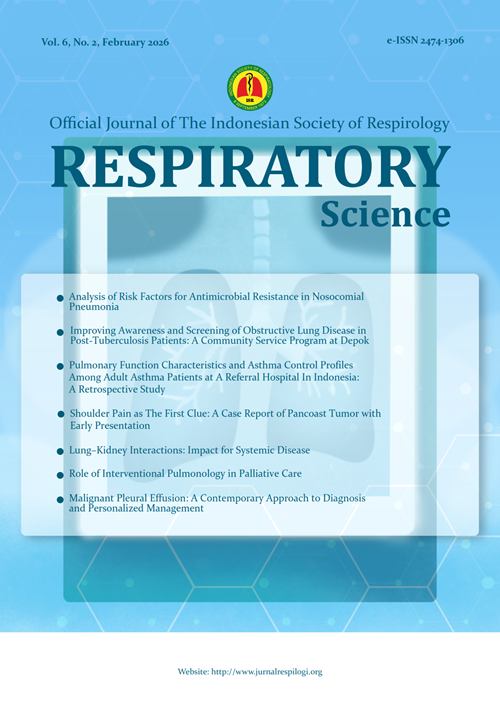
Pulmonary Function Characteristics and Asthma Control Profiles Among Adult Asthma Patients at A Referral Hospital In Indonesia: A Retrospective Study
DOI:
https://doi.org/10.36497/respirsci.v6i2.228Keywords:
asthma, asthma control, FEV1/FVC, pulmonary function test, spirometryAbstract
Background: Asthma is a heterogeneous chronic airway disease characterized by variable respiratory symptoms and airflow limitation. In secondary healthcare settings, objective assessment using spirometry is often underutilized, and discrepancies between symptom-based assessment and lung function may occur. This study aimed to describe the demographic, clinical, and pulmonary function characteristics of asthma patients and to examine their relationship with asthma control at Lawang Hospital.
Method: This retrospective cross-sectional study included asthma patients who underwent spirometry at the Pulmonology Outpatient Clinic of Lawang Hospital between 2022 and 2023. Medical record data included demographics, smoking history, comorbidities, atopic history, asthma symptoms, asthma control assessed using the Asthma Control Test (ACT) and Global Initiative for Asthma (GINA) criteria, spirometric parameters, and prescribed therapies. Pulmonary function patterns were classified as obstructive, restrictive, mixed, or normal. Associations were analyzed using chi-square tests, meanwhile correlations between ACT scores and spirometric values were assessed using Spearman’s correlation.
Results: Among 173 patients, most had a history of atopy (70.52%) and no family history of atopy (60.12%). Good asthma control based on ACT was observed in 72.83%, whereas only 1.16% were well-controlled according to GINA criteria. Most were partially controlled (89.60%) and had at least one asthma-related risk factor (78.03%). Pulmonary function patterns were obstructive (39.31%), restrictive (20.23%), mixed (27.17%), and normal (13.29%). No significant associations were found between patient characteristics and asthma control (P>0.05). Only the FEV1/FVC ratio showed a weak but significant correlation with ACT scores (P=0.012).
Conclusion: Asthma patients demonstrated diverse pulmonary abnormalities with limited correlation between symptoms and spirometry. Routine spirometry remains important to complement clinical assessment.
Downloads
Published
How to Cite
Issue
Section
License
Copyright (c) 2026 Respiratory Science

This work is licensed under a Creative Commons Attribution-NonCommercial 4.0 International License.